

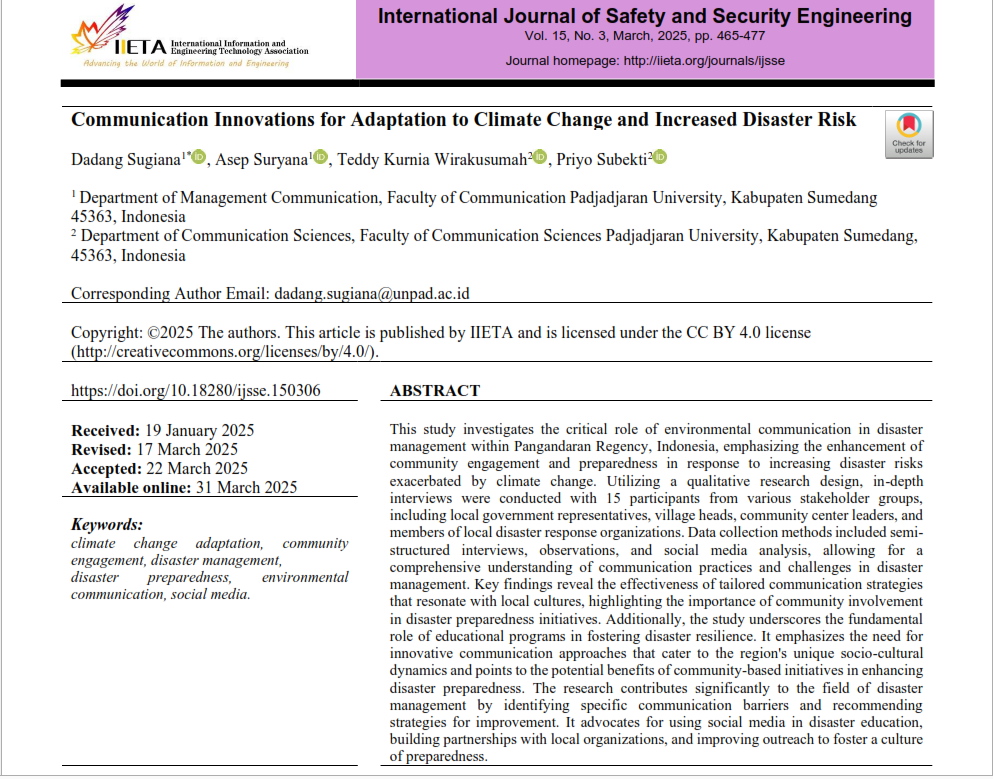
A collaborative research article authored by Dadang Sugiana, Asep Suryana, Teddy Kurnia Wirakusumah, and Priyo Subekti from the Faculty of Communication Sciences, Universitas Padjadjaran, has been officially published in the Q2-ranked International Journal of Safety and Security Engineering (IJSSE). The article, titled “Communication Innovations for Adaptation to Climate Change and Increased Disaster Risk”, presents a comprehensive qualitative study on the pivotal role of environmental communication in enhancing disaster preparedness and climate resilience in Pangandaran Regency, Indonesia.
Drawing from in-depth interviews with local leaders, disaster response teams, and community organizations, the study investigates how context-sensitive communication strategies—ranging from social media engagement to participatory disaster simulations—can foster a culture of preparedness and environmental stewardship.
The research underscores that effective communication is not merely about delivering information, but also about building trust, cultural resonance, and community participation in the face of escalating climate-related threats. The study found a 45% increase in disaster awareness following educational interventions such as the Tagana Goes to School and Disaster Preparedness Village programs, signaling the success of interactive and localized education strategies.
The article directly contributes to the achievement of several Sustainable Development Goals (SDGs), including SDG 11 (Sustainable Cities and Communities), SDG 13 (Climate Action), and SDG 17 (Partnerships for the Goals). It advocates for an integrated communication framework that combines traditional media, community workshops, and digital platforms to reach diverse populations and strengthen local resilience.
According to the authors, “Communication is not an auxiliary component of disaster management; it is central to empowering communities, reducing risk, and enabling long-term adaptive capacity.” The study also highlights how social media platforms—especially Facebook—played a crucial role in disaster awareness among youth, while traditional methods like community meetings remained essential for inclusivity.
The publication affirms Universitas Padjadjaran’s ongoing commitment to producing actionable, SDG-aligned research that addresses real-world challenges at the intersection of communication, sustainability, and disaster risk reduction.
Full article available at:
https://doi.org/10.18280/ijsse.150306


